Showing posts with label Japan. Show all posts

Wednesday, April 3, 2019

The Hare with Amber Eyes by Edmund de Waal

Several friends recommended The Hare with the Amber Eyes to me, given my interest in both Japanese art and Jewish history. This nonfiction paperback from 2010 reads like a mystery. When artist Edmund de Waal inherited a collection of 264 Japanese carvings, he decided to trace these netsuke through five generations of his family's tumultuous history.

The Ephrussis were once influential bankers and art patrons, like the Rothchilds, but after two world wars, little remained of their vast collections beyond the netsuke. De Waal travelled from his home in England to Paris, to Vienna, to Japan and to Odessa, collecting photos and documents, and interviewing survivors. Like a detective, he pieced together the clues to learn about his collection, the collectors, and how the Nazis nearly obliterated his Jewish family. Old photos illustrate his narrative, taking us back in history. His book was well written and very original.

While reading The Hare with the Amber Eyes, I had the opportunity to visit the Asian Art Museum in San Francisco, which has netsuke on display. The tiny figurines were designed as toggles for purses hanging off traditional Japanese garments since kimonos didn't have pockets. Carved of wood or ivory, the netsuke are small enough to hold in hand but are exquisitely detailed. Their often grotesque humor reminded me of gargoyles. The netsuke were invented in the 17th century and were popular until 1868, when Japan was opened to the West. I loved the story of how the Ephrussi collection returned to Japan, and how these small artifacts survived so much history. I wish the museum would let visitors hold their netsuke in hand.


While in California visiting my son at UC Berkeley, I took the train 15 hours south to meet Barrie Summy in San Diego. Although we've been crit partners for years, this was our first time meeting in real life. We talked enough for all that missed time. It was so much fun! I'm so grateful to Barrie for hosting this wonderful book review club for more than a decade and for connecting all of us through our shared passion for books and blogging. Thanks, Barrie!


Click icon for more
book review blogs
@Barrie Summy

Wednesday, December 12, 2018

Killing Commendatore by Haruki Murakami


Killing Commendatore by Haruki Murakami spoke to me as both an artist and a writer. His latest novel has the usual mix of morally ambiguous characters, a fathomless pit, and World War II atrocities. The only missing element was a talking cat, but painted characters sprung to life off the canvas and double metaphors become a tangible threat. This cerebral book is quite meta. Murakami is a master of magical realism and one of my favorite authors. His originality inspired me to write fiction.

Murakami's new novel is set in recent times, but the 36-year-old protagonist eschews technology to focus on abstract art after his wife leaves him. On a remote Japanese mountain, the unnamed protagonist encounters a charismatic older man whose generous patronage might be a blessing or a curse. He also befriends a 13-year-old neighbor, who reminds him of his deceased sister. Murakami's female characters are strong and complex, leaving the nurturing, supportive role to the reluctant hero. The narrative is mostly realistic with surreal detours. The plot is hard to summarize but was easy to follow.

I have never read a better depiction of an artist's inner process. The focus on inspiration and technique was somewhat like a modern version of Tracy Chevalier's Girl with a Pearl Earring. As a professional artist myself, I related to his struggle over painting freely versus creating commercial art for clients. I loved how the book showed the tortuous but satisfying journey of oil painting and the wide range of artistic expression. However, the ending could have done more with the protagonist's personal evolution as an artist.

"What I was teaching them was less how to draw than a way to view the world."

Killing Commendatore wasn't as perfectly crafted as A Wind Up Bird Chronicle or Kafka on the Shore, but I found it more compelling than his later novels. Although it wasn't as long as IQ84, 681 pages was still too heavy to hold in hand comfortably and too big to fit in my handbag so I read slowly. I enjoyed escaping into his imaginative world for nearly two months. I'd recommend Killing Commendatore to his fans and to anyone interested in art or Japan. With Chip Kidd's cool cover design (merging an eyeball with the moon), it would make a good gift.

The top photo of a remote temple village is from my sabbatical in Japan, where I was researching my work-in-progress, a noir mystery about a missing manga artist and gap year in Japan. I'll be offline until the weekend finishing a draft for teens and cultural sensitivity readers to read over vacation. Enjoy the holidays!

Click icon for more
book review blogs
@Barrie Summy

Wednesday, February 7, 2018

Pachinko by Min Jin Lee

Pachinko parlor in Nara, Japan

The sign of a good book is feeling bereft at the end. After finishing Pachinko by Min Jin Lee (2017), I spent days picking up new books and putting them down. I kept thinking about Lee's captivating characters and missing them as much as real people. This brilliant historical novel shows the plight of Koreans under colonial rule and as immigrants in Japan. By focusing on one peasant woman, Sunja, and her family from 1910 to 1989, history segways to near contemporary times and comes to life.

Under Japanese rule from 1910 to 1945, Koreans endured poverty, hunger, and rape. Some immigrated to Japan to live in slums. Even after World War II freed Korea, the Koreans who remained in Japan were treated as a legal underclass. Desperate immigrants opened pachinko parlors; the game is similar to pinball but with movable pins and gambling. Some Korean Japanese became involved with the yakuza (the Japanese mafia) and other nefarious vocations, leading to more social stigma even toward those working in lawful industries. The most intriguing character in Pachinko was a morally ambiguous yakuza boss.

Although I studied Japan at college, I learned a lot from Min Jin Lee. The Korean American author spent 30 years writing and researching Pachinko. It has a marvelous sense of place and period without info dumping. Her engaging story shows how racism takes an emotional toll on its targets. I won't demean her characters by calling them victims because they work hard to assimilate and take pride in their accomplishments. All the characters were well developed and their stories were inspiring.

I loved Lee's vivid descriptions of landscapes and characters:
"As they approached the forest located on the opposite side of the island, the enormous pines, maples, and firs seemed to greet them, decked in golds and reds as if they were wearing their holiday clothes." 
"Her expression was one of a small child who had been disappointed by her birthday present."
Pachinko parlor in Okinawa (from my sabbatical in Japan)

I would strongly recommend Pachinko to everyone. The historical sections from 1910 to the early 1960s were perfectly crafted, but the more contemporary part read a bit like a prolonged epilogue with a message. Still, it was important to have the narrative stretch to more current times. My husband, who is a professor of Japanese politics, had a similar reaction, and my mother loved it too. We are still casting around for new books that will be as satisfying as Pachinko so I'm hoping to find one from the reviews linked to this post.

Click icon for more
book review blogs
@Barrie Summy

Tuesday, November 29, 2016

Temples & Gardens of Kyoto at Peak Foliage

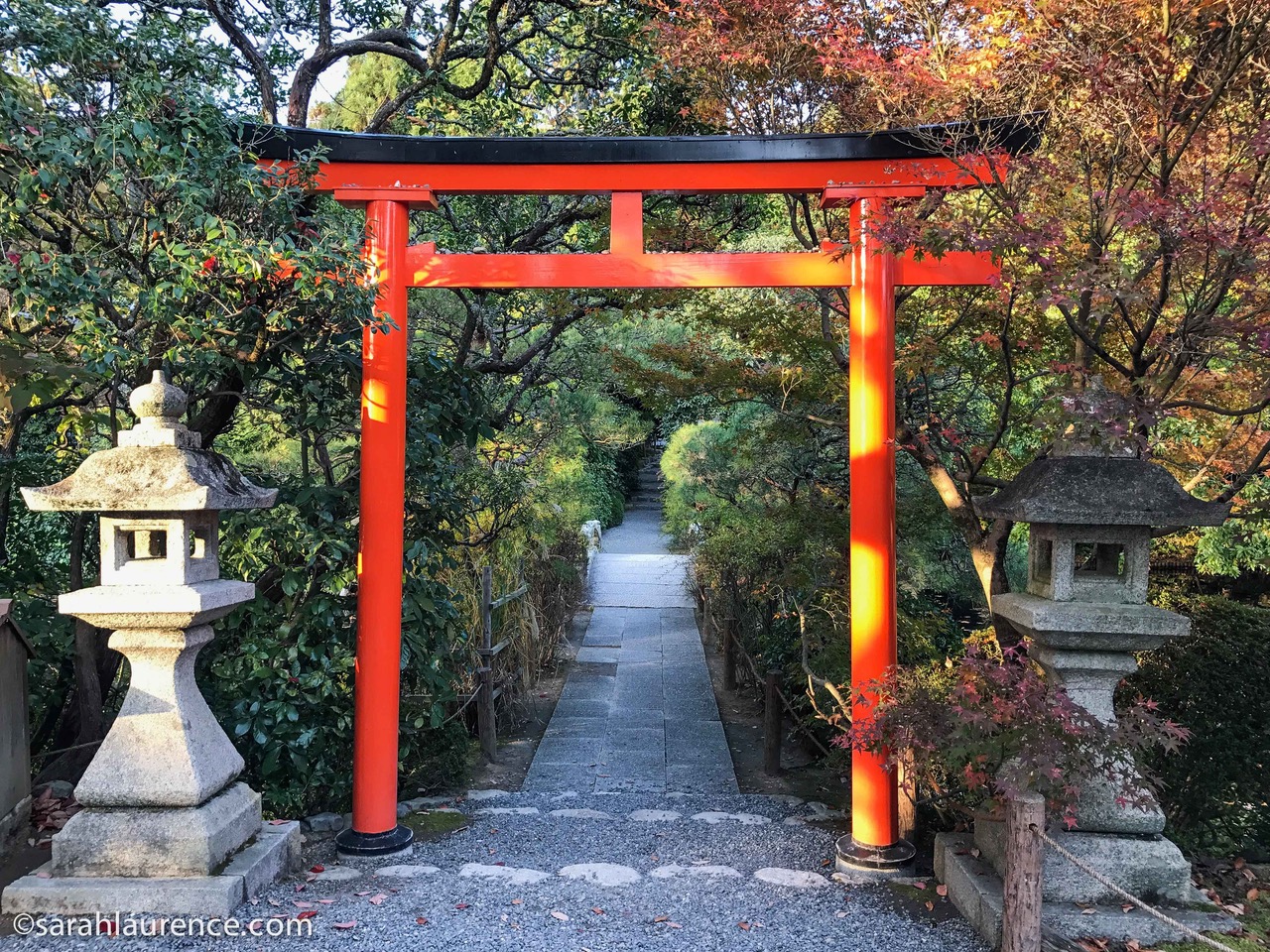
Gate to Shinto shrine at Ryoan-ji Temple, Kyoto

If you're visiting Japan, plan on several days in Kyoto if you enjoy gardens and historic architecture. This post includes only five of the 1,600+ Buddhist temples in the prefecture. Japanese temples frequently combine elements from their two national religions, like the traditional gate to a Shinto shrine (above) and the Buddhist garden (below) at Ryoan-ji Temple.

Ryoan-ji's rock garden with fall foliage.

Ryoan-ji in April
Photography fails to capture the minimalist beauty of Ryoan-ji's famous rock garden, which must be seen in person. The mossy rocks are islands in a gravel sea. In spring that bare tree drips cherry blossoms over the wall .

I have now seen Ryoan-ji in three seasons and would return a fourth time to see it in snow. That won't happen this sabbatical since my husband and I are going home to Maine for our kids' winter break from college.

Our kids were only three and six when we took them to Kyoto for cherry blossom season during my husband's last academic sabbatical to Japan. Henry teaches Japanese Politics at Bowdoin College and speaks the language but not fluently. Before he became a professor, he worked for the Bank of Tokyo in London.

Japanese maples and persimmons at Ryoan-ji

The first time I visited Japan, I was nineteen and it was brutally hot and muggy in August. The grounds of Ryoan-ji were refreshingly cool in summer but are at their most glorious when the maples turn color. The orange fruit hanging from bare trees are persimmons, which taste like papaya when ripe.

Japanese maples at Ryoan-ji in peak foliage 11/18/16
Cherry blossom season (early April) and peak fall foliage (late November) draw big crowds to Kyoto for good reasons, especially at Ryoan-ji. Pack warm socks since you remove your shoes inside temples.

Manshu-in Temple in Kyoto

Although Japanese people usually wear western clothes, women and girls occasionally dress in kimonos to visit temples and to pray in shrines. Newlywed couples in traditional dress pose for photos too. The open porch of a Buddhist temple is designed for garden viewing and meditation. Manshu-in Temple (above and below) can't be reached by bus since the mountain village roads are too narrow.

Manshu-in rock garden 11/19/16

To avoid the weekend crowds, we chose two remote temples Manshu-in (above) and Enkou-ji (below). Their websites are only in Japanese. Enkou-ji is in walking distance of Manshuin.

Enkou-ji Temple in peak foliage 11/19/16

The summit trail offers a spectacular view of Enkou-ji Temple and Kyoto.


In the early evening, lanterns illuminate the gardens. This rock garden is not as subtle as Ryoan-ji, but the more pronounced rake patterns makes it easier to photograph.


If you're a fan of samurai movies, Daikaku-ji Temple (above and below) may look familiar.


The buildings are connected by covered walkways overlooking the inner gardens.


The screen art in the tatami rooms is exquisite too.


Daikaku-ji's outer garden has a pagoda and a lovely path around a pond. 

Kinkaku-ji is also called the Golden Pavilion (photo from my April 2003 visit to Kyoto).

People travel from all over the world to see Kyoto temples, but there are far more visitors from East Asia, especially China, than from the West. If you're visiting at a less crowded time, I'd also recommend The Golden Pavilion (Kinkaku-ji), The Silver Pavilion (Ginkaku-ji) and The Moss Garden (Saiho-ji Kokedera).

Mt. Fuji from the shinkansen. Photo by my husband (his turn for the window seat).

Kyoto is only 2 1/2 hours by shinkansen from Tokyo. On a clear day, you can see Fuji-san from the north side of the high speed train. I can't recommend hotels since we stayed with an old friend in the neighboring prefecture of Nara. I'm considering all these locations for my novel, but I'll save Nara for another post. I don't know how I'll choose a setting among all these gorgeous options.

Thursday, November 10, 2016

Researching a Novel in Japan

Entrance to the Meiji Shrine Inner Gardens in Tokyo

Konichiwa from Tokyo! With both of our kids at college, I was free to join my husband on a two month sabbatical to Japan. I apologize for not updating my blog regularly, but it has been a busy transition. In June I signed with a new literary agent, Sara Crowe. Since receiving her excellent editorial notes, I've been revising a young adult novel set in Maine while planning a new YA novel set in Japan. Henry and I have now been here for three and a half weeks. Given the political situation in the USA, I alternate between homesickness and feeling sick of home.

Japan 1101 class photograph by Anna Aridome. 

It's a big responsibility writing about a country that is not your own culture. Although my brother is married to a Japanese woman and they speak that language with their kids, I knew only a handful of words. In late August I enrolled in Japanese 1101 at Bowdoin College, where my husband teaches Japanese Politics. The US Department of State recommends 800 hours of instruction to become proficient in a romance language but 1,800 hours of class for Japanese or Chinese. Japanese has three alphabets. After five weeks of instruction, my class had only mastered two: hiragana is phonetic and katakana is for foreign words/names. Those two are easier than the kanji imported from China. Sentences contain all three alphabets. Most student would take two years of Japanese before junior year abroad or a summer internship. We had a fabulous teacher, but I needed to work twice as hard to keep up with these gifted young linguists. Never have I done anything more difficult. 


My husband speaks Japanese so he took care of the logistics for our trip. We spent our first ten days in hotels, recovering from jet lag and waiting for our apartment to be available. Henry chose the Hotel New Otani in Tokyo because he knew I'd love its garden (above and below). 


Our sabbatical is doubling as an anniversary celebration for us and this hotel is also a popular wedding site. Sometimes the bride and groom dress in both traditional and western dress. The couple above gave me permission to take their photo. Except for holidays and weddings, most Japanese people dress in western clothing and live in western style apartments in cities. 

Tokyo from the Hotel New Otani. The green space is the Akasaka Palace grounds and mostly closed to the public.

I grew up in Manhattan and lived two years in London, but Tokyo is the most urban place I've ever experienced. There are few trees on sidewalks and fewer public parks. Even my limited knowledge of Japanese has been useful as I venture out alone in Tokyo. My iPhone with a Japanese SIM card is my map and dictionary. Simple chores like shopping for groceries and reading signs or menus are challenging. Swimming laps is an extra workout with my phone and phrasebook in the locker room. People try to be helpful but most speak limited or no English. This is my third visit to Japan, but I still feel unprepared. I continue to study the language on my own.

Can you find the moon in Shibuyu?

There are manga museums and teen hangout spaces to explore so I keep pushing beyond my comfort zone. The flashing neon lights, dense crowds and busy roads can be overwhelming. Imagine Times Square on steroids with a more homogenous population. There are few immigrants, expats or foreign tourists (most are Chinese) so we are a curiosity in our residential neighborhood of Shibuya. 


We found our airbnb apartment through a friend of a friend. The rooftop apartment with its balcony garden is an ideal writing retreat. Bird song wakes me in the morning and the tatami room is a soothing space to unwind after work. The remainder of the apartment is western style, although the bathtub talks and the toilet spritzes water and plays music. My brilliant husband deciphered the kanji to change the toilet's tune from Pachelbel's Cannon to traditional Japanese koto music. Like we new empty-nesters don't already feel like newlyweds in a tiny apartment!

The control panel for our toilet
In our new home we prepare mostly Japanese food, except at breakfast. I was very proud to read the katakana for fruit granola, which I found at 7-Eleven. In Japanese, milk translates to cow juice, but often they use our English word written in katakana. A Japanese breakfast is rice, pickles, miso soup and green tea or coffee. At the hotel buffets, I often combined both. 


As I struggle to adapt to my new environment and language, I'm gathering first hand experiences for my novel. Plus writing in English now seems easy by comparison! Later I'll blog about our trip to Okinawa (below) and to other places that I'll be visiting soon for research. Due to my travel and work schedule, I'll be posting irregularly. I update more frequently on twitter and Facebook.


Blogwatch: I'm looking forward to catching up with my blog buddies now that Google Blogger has reinstated my blogroll. The loss of those links for weeks was another reason I stopped posting. Blogging is meaningless without the community. It's nice to be back online!

Next Japan sabatical post: Temples & Gardens of Kyoto at Peak Foliage

Wednesday, November 11, 2015

Author Lois Lowry at Bowdoin College

Author Lois Lowry listening to a question from a Bowdoin student.

My son introduced me to Lois Lowry. He'd read The Giver for sixth grade English and thought I would like it. I loved it. Lowry's dystopian novel reminded me of George Orwell's 1984 and Animal Farm, but The Giver felt darker because it's a children's book. The evil overlords weren't faceless bureaucrats or talking pigs but trusted parents and teachers. A boy who learns the truth must fix a world ruined by his beloved elders. This 1994 Newbury Medal winner defines the Millennial generation. It's a perfectly crafted novel with ageless appeal. The Giver was also one of the books that motivated me to write young adult fiction.

Speaking at Bowdoin College two days ago, Lowry shared her inspiration for The Giver. Her father was suffering from dementia and failed to recognize a photo of his deceased daughter. Lowry had to remind him about what happened to Helen over and over again. She became his memory keeper and a book was born. In The Giver a dystopian society has chosen to forget the evils of the world. Only the Giver remembers everything, and in his old age, he must pass all those memories onto his young disciple. The truth nearly breaks Jonas, a 12-year-old boy who must act as a man.

Although best known for The Giver, Lowry has written over forty children's books. Her first novel, A Summer to Die (1977) was inspired by the death of her sister. Her favorite is Autumn Street (1980), an homage to her grandparents' cook whose child was murdered. Number the Stars, set in Denmark during World War II, won her first Newbury Medal in 1990. She has also written lighter, humorous books for young readers. According to Lowry, the theme that unites all her work is reconciliation.


The author at age three getting a reading lesson from her six-year-old sister Helen. 

Lowry's personal story was interesting too. Born on Hawaii Island in 1937, Lowry moved to New York City right before the bombing of Pearl Harbor. Her father was General MacArthur's dentist so the family relocated to Japan during the Occupation. In Washington D.C., her dad cared for the Nixon family teeth. Back in New York City, Lowry won a national poetry competition, which earned her a writing scholarship to Brown. When the poetry book was published, Lowry was horrified to learn that her high school teacher had rewritten her poem. Like many women in the 1950s, Lowry dropped out of college to get married. She later completed her education while raising four kids in Maine. Her first book was published when she was forty. Lowry now has a graduate degree, several honorary degrees (including one from Brown), two Newbury Medals, and four grandchildren. At age seventy-eight she is still writing new books.

Questions for Lois Lowry from the audience at Bowdoin College.

Lowry writes children's books because "kids are changed by what they read." She shared some reader emails and answered the questions of the enthralled Bowdoin students in the audience. Her responses were heartfelt and often hilarious. I'd gone to Lowry's talk with young adult author Maria Padian, and what surprised us the most was how funny Lois Lowry was in person. Lowry shared family photos, news clippings and book covers. A photographer myself, I was impressed to learn that the iconic cover photo of The Giver was one of hers. I remember the challenges of SLR cameras and darkroom photography before Photoshop. She is clearly a woman of multiple talents. I left Lowry's talk feeling inspired.

Simpson's Point in Brunswick, Maine at sunset.

Wednesday, February 4, 2015

No Surrender Soldier by Christine Kohler & Blizzard Photos

A Japanese soldier hiding on a tropical island for 18 years after Word War II ended? That sounds like pure fiction, but No Surrender Soldier was inspired by a true story. American author Christine Kohler has lived in both Japan and Guam. Her firsthand knowledge brings an historical incident to life with fictional characters. This engaging young adult novel would make a marvelous supplement to the history classroom, as it touches on both World War II and the Vietnam War.

No Surrender Soldier is set in 1972 on the Island of Guam (a US territory.) Fifteen-year-old Kiko chases a baseball into the jungle and finds a Japanese soldier hiding in a cave. His family history makes the encounter all the more horrific: during World War II, a Japanese soldier raped his mother, and now Kiko's brother is missing in action in Vietnam. Kiko is torn between his desire for revenge and his empathy for the old soldier. He's a believably impulsive teenager who hungers to be a man. This is a coming of age story with solid values.

What I loved best about No Surrender Soldier was how it treated the Japanese and Guam cultures with even-handed respect while acknowledging the atrocities of war. Kiko is native to Guam but his best friend is Japanese. Tourists from Japan help his family's business. The story is told in alternating chapters so that we can see inside the Japanese soldier's head and empathize with his harrowing struggle for survival. Seto's flashbacks to his boyhood (including baseball) and his shame over disappointing the emperor make him a sympathetic but scary character.

The writing was accessible with occasional poetic interludes in Seto's voice:
Not raining leaves, nor whistling wind, not gonging bamboo, nor droning airplanes - especially not the bombers - could drown out the sound of a thousand soldiers marching. Marching. Marching.
This fast-paced novel would appeal especially to boys aged eleven to fourteen. Kiko is a young, boyish fifteen. There are lots of gross-out survival details like eating rats, although talking to a girl is even scarier. I had a hard time reading the detailed description of butchering the family pig, but Kiko suffers even more because he loves his pet. The gory violence of that scene was not gratuitous since it foreshadows what may come later. Although the story has plenty of educational value and religious moments, it never sounded didactic or preachy. No Surrender Soldier was designed to be read under the covers with a flashlight.

Reviewer's Disclosure: I bought this 2014 ebook myself. It's also available in hardcover from Merit Press, a new publisher of young adult fiction. I have a personal interest in Japan. My husband teaches Japanese Politics at Bowdoin College and my sister-in-law is Japanese.

Click icon for more
book review blogs
@Barrie Summy

Photos from the Blizzards of 2015

We've had three major storms (four snow days) in the past week, dumping about three feet of snow.

 That's not counting the drifts due to high winds. I have to "walk" Scout on skis. She follows in my tracks.

 My daughter has been a big help with the shoveling...Scout less so.

In my seventeen years in coastal Maine, I've never seen so much snow. Nothing melts in single digit temps.

The skiing has been great so I'm not complaining.
More is due tonight!

Wednesday, July 17, 2013

Ink by Amanda Sun, revisiting Japan


My photo of Ryoan-ji
After my first year of college, my family visited Japan and Hong Kong. I'd taken a couple of courses on Japan and written a term paper on Japanese gardens. Even so, I was not prepared for the beauty of the gardens and temples. I vowed to return in cherry blossom season, and I did, this time with my own children. My husband teaches Asian Studies and Government at Bowdoin College and was granted a sabbatical in Japan. It was a magical experience. We met up with my high school friend Terry Kawashima and my sister-in-law's parents (first photo). My brother worked as an architect for three years in Japan and met his wife there. I'll be recommending Ink, a new young adult novelto their 12-year-old daughter, as she loves fantasies and drawing. I think my 16-year-old daughter (the 3-year-old in the photo) would enjoy it too.

Canadian author Amanda Sun merged her experience as an exchange student in Osaka with Japanese mythology to create her debut novel, Ink (June 2013). After her mom dies, sixteen-year-old Katie Greene is sent to live with her English teacher aunt in Shizuoka. As the only foreign student (presumably), she catches the eye of Tomohiro, the star of the school's kendo team. Tomo is also a skilled artist, but he hides his talent. His drawings have a bad habit of leaping off the page and attacking bystanders. One nearly killed his best friend. Yakuza gangsters and the kami paper gods vie for his allegiance. Katie fights to protect Tomo, but her presence only makes his power harder to control. Their star-crossed romance is Twilight remixed with Harold and the Purple Crayon.

Not only is Ink a good story, it's a fine introduction to Japanese culture. The characters practice calligraphy, go to cram school and celebrate cherry blossom season. They also goof around and get into trouble like teens everywhere. The whimsical magical scenes, beautifully illustrated, draw as much on manga comics as on Japanese mythology. The fantastic is well balanced by a realistic sense of place. Katie is a sympathetic, likable protagonist who works hard to understand a foreign culture and to accommodate the new norms, often making embarrassing mistakes as she learns. As a former foreign exchange student and then manager of a foreign exchange program, I could relate to her experience. Japanese words are described in context and in a glossary. Sun does an excellent job of transporting readers to Japan without losing them.

Although the Japanese part of the story was well developed, the American backstory was not. Katie's closest relatives are conveniently missing: her dad vanished (why?), her mom died recently and her grandfather is fighting cancer. Her near-stranger aunt in Japan is the only well developed adult character. There is no mention of the friends Katie left behind or of her past life in NYC beyond ballet. Obviously she would miss her mom, but teens are mostly focused on their peers. It would have been extra-traumatic leaving them behind. The only friends mentioned are new ones and, like her facility with the difficult language, seem too easily acquired.

We know nothing about Katie's romantic past either. Perhaps she doesn't have one. Katie is a bit immature, behaves awkwardly and doesn't know how to flirt so why do the two hottest guys fall for her? This question is semi-answered toward the end, and hopefully her background will be fleshed out later in The Paper Gods trilogy. The page-turner ending of Ink leaves the reader eager for more.
"Clouds of shimmering dust encircled him, wisps of inky swirls that glinted in the sunlight. They curled in slow motion, spreading around him like waves of fireflies."
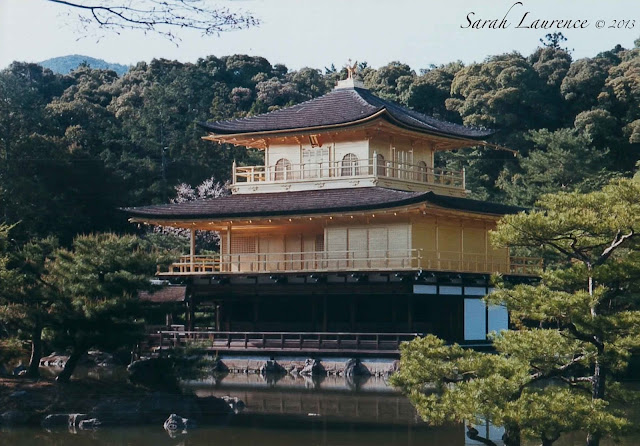
The Golden Pavilion (Kinkaku-ji) in Kyoto, Japan
Reviewer's Disclaimer and Recommendations: I received a free digital galley from Harlequin Teen but was not compensated for my review. I flipped through the gorgeous paperback at Main Point Books, and I'd recommend buying a hardcopy from an indie bookstore. The cover image of Katie is far more glamorous than I imagined her, but Tomo's ink drawings were just right. The illustrations didn't look as good on my ereader and the glossary was harder to access. Although the action scenes are violent, the romance is quite innocent and would be fine for tweens as well as teens. Ink would crossover to adult fans of manga and of YA paranormal fiction. Ink was on my Good Summer Books list.