Showing posts with label Bowdoin. Show all posts

Wednesday, September 20, 2017

In-Flux-Out by Isabelle Pelissier & friends


I was walking in the woods when my usually quiet dog started barking: Men with chainsaws were chopping down trees! I shared Scout's dismay, but this was not our property so we continued on our way. A few days later we returned, and to my delight, instead of a clear cut, we found a sculpture garden.


Scout was transfixed, wagging her tail like she'd spotted a wild animal.


Then she turned to me grinning, inviting me to come closer.


I walked around the installation, watching how the iron caught the sunlight through the trees.


The tentacles seemed to move like an octopus underwater. I wondered who had created this gorgeous work of art and why it was installed in these woods.


Once again, Scout retrieved the answers from a pamphlet hanging from a tree:


Isabelle Pelissier's In-Flux-Out can be viewed from the paths 
off Pickard Fields at Bowdoin College in Brunswick, Maine.


Happy Rosh Hashanah! 
May this new year be better than the last.

Wednesday, July 13, 2016

ALL AMERICAN BOYS by Jason Reynolds & Brendan Kiely

I read All American Boys in response to the police violence of last week. The news read like a dystopian novel: police officers had killed 2 more African Americans, and an army veteran had shot 12 policemen, 5 fatally, in retaliation. Then DeRay Mckesson, a Black Lives Matter activist, was arrested with undue force during a peaceful protest in Baton Rouge, Louisiana. The incident was captured on his and other cell phones and went viral. My tweet in support of DeRay caught the attention of racist trolls, whom I ignored.

DeRay's violent arrest hit me on a personal level. I'd heard him speak eloquently at his alma mater, Bowdoin College, and no one is working harder than he is to find a non-violent, political solution to the problem of police brutality. My husband teaches politics at Bowdoin and is friends with DeRay. We were appalled by his arrest. After making a donation for the protestors' bail and legal services, I retreated to the comfort of a good book.


Black Lives Matter activist DeRay Mckesson being arrested in Baton Rouge. Photo by Max Becherer  7/9/16

All American Boys tackles police brutality and racism with a gritty realism that will resonate with both teens and adults. This empowering story is narrated in alternating voices: Rashad, the black victim, and Quinn, his white classmate who witnesses the beating and runs away. The coauthors, Jason Reynolds and Brendan Kiely, mirror the ethnicity of their protagonists.

Author Jason Reynolds
In the opening chapter, Rashad changes out of his junior ROTC uniform into street clothes and stops at a convenience store to buy a snack. When a white woman accidentally trips over Rashad and falls, the shopkeeper accuses him of theft. A white policeman drags Rashad outside and beats him so badly that he requires hospitalization. The incident is caught on cell phones and goes viral. Without his consent, Rashad becomes a hashtag.

Author Brendan Kiely
Quinn, the teenage eyewitness, struggles with his conscience. The brutal policeman was no stranger; Paul is his best friend's older brother. When Quinn's dad died while fighting in Afghanistan, Paul had stepped in as a surrogate big brother and taught him how to shoot hoops. Quinn's basketball prowess may earn him a free ride to college. Quinn is torn between his loyalty to Paul and "doing the right thing." The moral dilemma plays out at home, at school and on the basketball court as friends and family take opposing sides.

All American Boys is anti-brutality but not anti-police. All the characters have strengths and weaknesses; they are realistically human. Although the protagonists are boys, many of the strongest characters are girls and women. The story is emotionally challenging but easy to follow. After an explosive start, the pace slows in the middle as momentum builds to the climax. The heart-wrenching ending left me in tears but not without hope. I'd strongly recommend All American Boys to everyone, whatever your age, ethnicity or gender. This powerful book should be required reading in American high schools and at police academies. It would make for an excellent book group discussion too.

The iconic image of the Baton Rouge Protest Against Police Brutality by Jonathan Bachman for Reuters July 2016

By the time I'd finished reading All American Boys, our friend DeRay had been released on bond and is now back at his advocacy work. Follow this link to his Campaign Zero for an interactive tool that allows you to track the progress of police violence legislation on the local, state and national levels. Change isn't going to happen unless we hold legislators accountable and push for progress.

Reviewer's Disclosure: I bought this book in 2015 and lost it in my to-be-read stack. Thanks to a nudge from YA author I.W. Gregorio of We Need Diverse Books, I remembered to read it now. Another book we both recommend is Ta-Nehisi Coates's memoir, Between the World and Me. I write and review YA fiction, but my academic degrees are in Political Science. Author photos are from twitter.

Thursday, March 10, 2016

A Walk from Bowdoin College to the Androscoggin Swinging Bridge


Only a good friend would brave Maine at this time of year. I met Sherry during my junior year abroad in London. She's always been a game traveler. On a previous visit, we'd gone cross-country skiing in our woods, but it's been a freakishly warm winter in New England.


My house is next door to Bowdoin College, where my husband teaches Japanese and British Politics.


You might recognize my husband as Lord Grantham on Downton Abbey. Thanks to Bowdoin art professor Mark Wethli for the uncanny PhotoShop job! Yes, we are mourning the end of that gig.


Bowdoin has deeper roots in the past: it was founded in 1794. Massachusetts Hall, the oldest building on campus, dates back to when we were part of Massachusetts. Maine didn't become state until 1820.


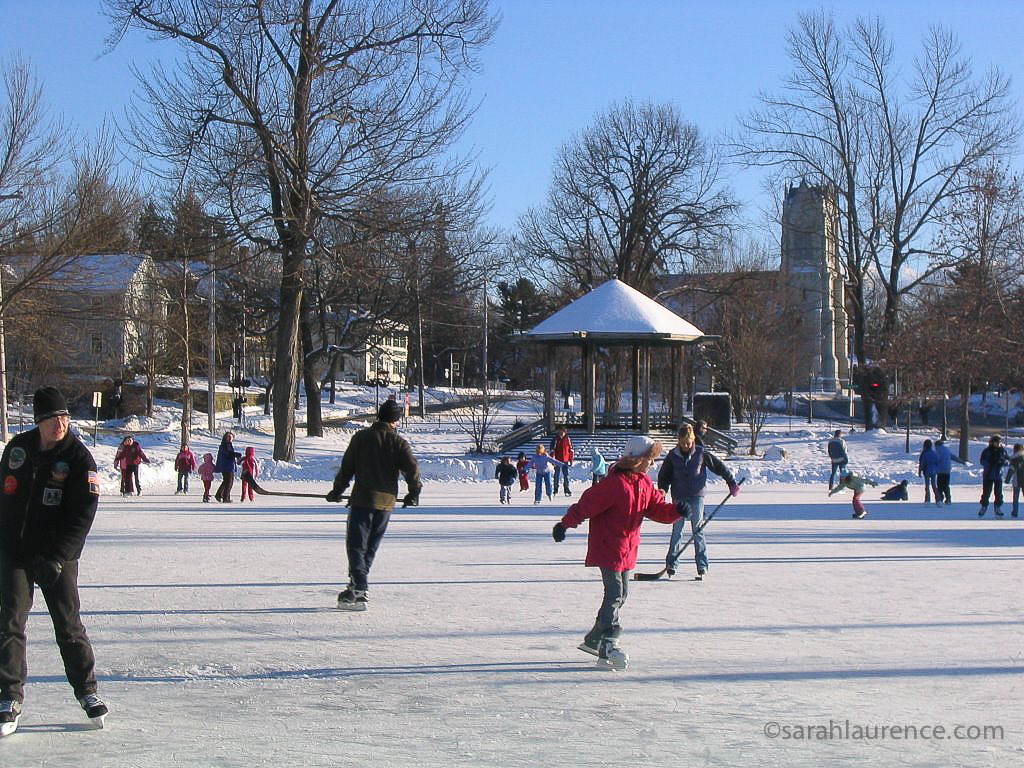
Another old campus beauty is Searles Hall. During winter the quad is flooded to become a skating rink.


Bowdoin is located in Brunswick, the biggest town in Maine with a population of 20,000.


There are plenty of mom and pop stores like Frosty's Donuts (circa 1965).


 Keep walking, folks. We don't need a warm-out-of-the-oven wild blueberry doughnut...maybe later?


Time to cross the bridge over the Androscoggin River to Topsham, past Sea Dog Brewing.


The dam once powered the Androscoggin Mill. Now the mill houses art studios, restaurants, a flea market, an indie movie theater, our local radio station, and the winter farmers' market (on Saturday mornings).


The Androscoggin Swinging Bridge from Topsham to Brunswick, Maine
On the Topsham bank of the Androscoggin is a lovely path leading to the Androscoggin Swinging Bridge.

This footbridge was built in 1892 by John A. Roebling's Sons Co., who also designed and built the Brooklyn Bridge. No joke!

A transplanted New Yorker myself, I find this fact reassuring, despite the pronounced bounce underfoot.

Factory workers used the bridge to commute from their dormitory style housing in Topsham to the cotton mill in Brunswick.

This scenic walk is a three-mile loop from my front door.

I love my town!

Blogwatch: This post is part of Les@TideWaterGarden's Winter Walk Off. If you want to share a winter walk from your home, post it by March 19th with a link to Les. Links to more Winter Walk Off posts coming next week.

Wednesday, November 11, 2015

Author Lois Lowry at Bowdoin College

Author Lois Lowry listening to a question from a Bowdoin student.

My son introduced me to Lois Lowry. He'd read The Giver for sixth grade English and thought I would like it. I loved it. Lowry's dystopian novel reminded me of George Orwell's 1984 and Animal Farm, but The Giver felt darker because it's a children's book. The evil overlords weren't faceless bureaucrats or talking pigs but trusted parents and teachers. A boy who learns the truth must fix a world ruined by his beloved elders. This 1994 Newbury Medal winner defines the Millennial generation. It's a perfectly crafted novel with ageless appeal. The Giver was also one of the books that motivated me to write young adult fiction.

Speaking at Bowdoin College two days ago, Lowry shared her inspiration for The Giver. Her father was suffering from dementia and failed to recognize a photo of his deceased daughter. Lowry had to remind him about what happened to Helen over and over again. She became his memory keeper and a book was born. In The Giver a dystopian society has chosen to forget the evils of the world. Only the Giver remembers everything, and in his old age, he must pass all those memories onto his young disciple. The truth nearly breaks Jonas, a 12-year-old boy who must act as a man.

Although best known for The Giver, Lowry has written over forty children's books. Her first novel, A Summer to Die (1977) was inspired by the death of her sister. Her favorite is Autumn Street (1980), an homage to her grandparents' cook whose child was murdered. Number the Stars, set in Denmark during World War II, won her first Newbury Medal in 1990. She has also written lighter, humorous books for young readers. According to Lowry, the theme that unites all her work is reconciliation.


The author at age three getting a reading lesson from her six-year-old sister Helen. 

Lowry's personal story was interesting too. Born on Hawaii Island in 1937, Lowry moved to New York City right before the bombing of Pearl Harbor. Her father was General MacArthur's dentist so the family relocated to Japan during the Occupation. In Washington D.C., her dad cared for the Nixon family teeth. Back in New York City, Lowry won a national poetry competition, which earned her a writing scholarship to Brown. When the poetry book was published, Lowry was horrified to learn that her high school teacher had rewritten her poem. Like many women in the 1950s, Lowry dropped out of college to get married. She later completed her education while raising four kids in Maine. Her first book was published when she was forty. Lowry now has a graduate degree, several honorary degrees (including one from Brown), two Newbury Medals, and four grandchildren. At age seventy-eight she is still writing new books.

Questions for Lois Lowry from the audience at Bowdoin College.

Lowry writes children's books because "kids are changed by what they read." She shared some reader emails and answered the questions of the enthralled Bowdoin students in the audience. Her responses were heartfelt and often hilarious. I'd gone to Lowry's talk with young adult author Maria Padian, and what surprised us the most was how funny Lois Lowry was in person. Lowry shared family photos, news clippings and book covers. A photographer myself, I was impressed to learn that the iconic cover photo of The Giver was one of hers. I remember the challenges of SLR cameras and darkroom photography before Photoshop. She is clearly a woman of multiple talents. I left Lowry's talk feeling inspired.

Simpson's Point in Brunswick, Maine at sunset.

Wednesday, October 28, 2015

A Walk at Bowdoin College


It's hard to work at home when the trees are calling me outside. 


A day of writing merits a walk to Bowdoin College...


...says Scout. 


Rolling in fallen leaves offers a fine view of the sugar maples.


Often we linger to watch the sunset over Hubbard Hall, 
where my husband teaches politics.


Other days we head home for sundowners in our backyard, 
wrapped in fleece and down.


The view from inside isn't too shabby, 
and reading in the tub doesn't feel like work at all.

Wednesday, March 25, 2015

My Town: Brunswick, Maine

  
Brunswick looks best in winter white. Yes, I know it's "spring," but my town has an offbeat sense of humor. Read the road sign: Maine Street. Brunswick has a population of 20,000, making it the biggest town in Maine. It's a half an hour up the coast from Portland; our biggest city has only 60,000 people.


Brunswick officially became a town in 1717 when Maine was part of Massachusetts. Maine didn't become a state until 1820. Lovely old houses line the town green, which isn't very green at this time of year.


In winter the town green becomes a skating rink.


We are well prepared for winter. Even the sidewalks are plowed and sanded.


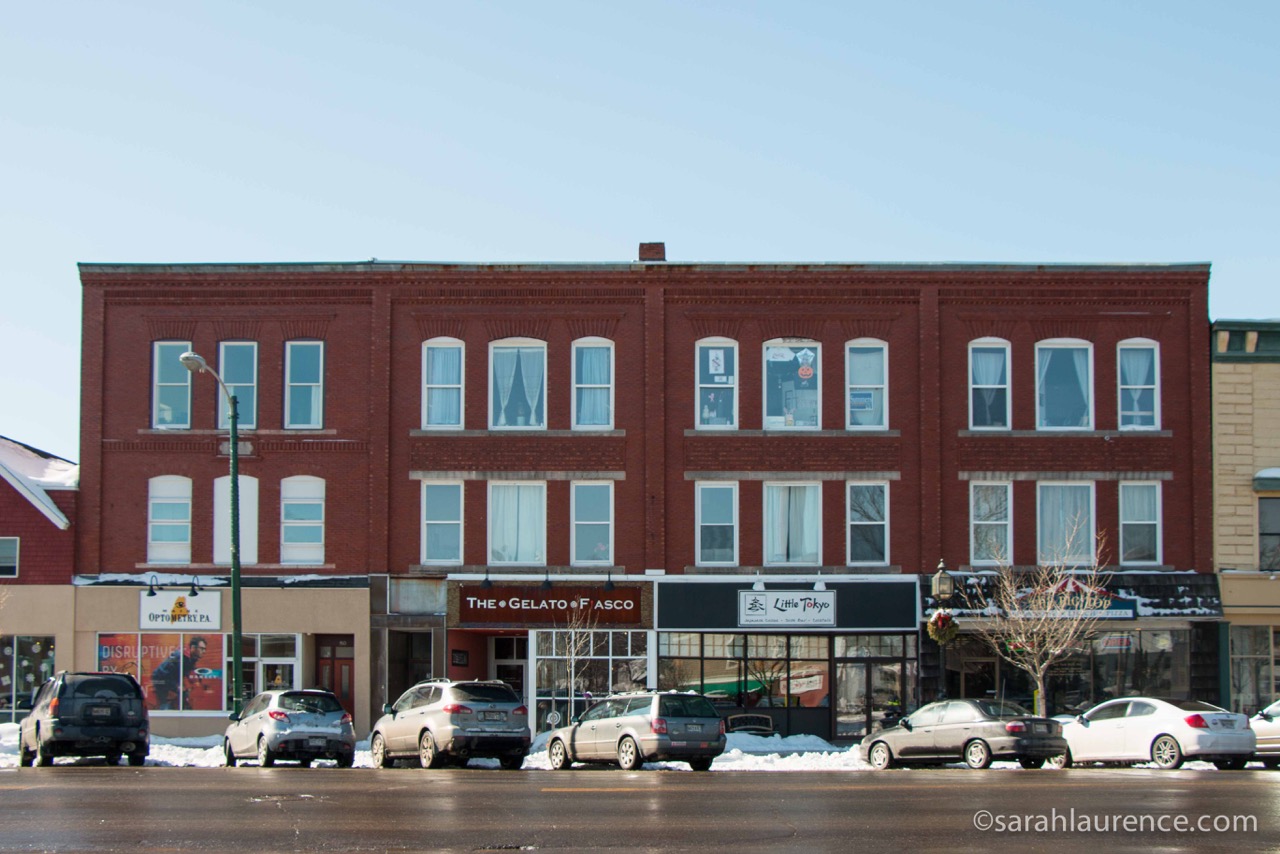
Downtown hosts a variety of ethnic restaurants and mom & pop businesses in Hopper style buildings.


There are several art galleries and more artists than I could count. Frosty's bakes fresh "donuts" daily.


Of course there is a barber shop.


The architecture can't have changed much since the 1950s.


Fort Andros, the old cotton mill on the Androscoggin River, 
now houses art studios, restaurants, a flea market and the winter farmers' market.


At the other end of town is Bowdoin College, founded in 1794.


My husband teaches British and Japanese Politics in Hubbard Hall.


Mass Hall, the oldest building on campus, houses the English Department.


Another favorite building is Searle's Hall.


The campus has a lovely chapel too.

I love my town!

Blog Watch: check out Winter Walks of 2015 @Tidewater Gardener.