Changes in the Weather is a young adult novella about climate change told in four distinct voices. In "Wind" a hurricane forces Isla's family into a nomadic motel existence. Prolonged drought in "Earth" sucks the life blood from the farm of Ava's grandmother. While in "Water" too much rainfall threatens Xenia's riverside town. The aftermath of "Fire" leaves Natasha to nurture her younger siblings while their mother undergoes surgery. In each story a teenage girl finds herself in a new role as climate disaster upends her life. Although the book is a work of fiction, it rings all too true to life right now.
Debut author Leela Marie Hidier, a teenage girl herself, did a phenomenal job in distinguishing the voices of her protagonists and making them and their environment believable through well observed sensory details, secret thoughts, and solid climate research. Each of the girls has a unique personality and family situation which shape their differing responses. Coddled Isla uprooted from her nurturing neighborhood becomes rebellious. Privileged Ava tries to escape into a romantic oasis. Alienated Xenia seeks solace in music. Steady Natasha records every detail like a reporter. Their struggles to adapt to the rapidly changing world make for compelling stories, both personal and universal, which all interconnect in the satisfying concluding segment.
The writing was strong and clean, packing an emotional punch from the first chapter. Here's Isla on abandoning her only home in a hurricane: "I wonder what else I would have taken if I'd had more time. Maybe I would have taken more time."
Author photo by Winky Lewis
The publisher and sponsor of this marvelous debut is The Telling Room, a non-profit organization which supports emerging young writers in Maine with a diversity of experiences. Leela was born in London to an American mother and a French father. I first connected with her family through reviewing another debut novel, Born Confused, by her mother, Tanuja Desai Hidier. I was delighted when the Hidiers relocated near me in Maine five years ago. Leela asked me to beta read her penultimate draft, and she's done a remarkable job in writing and revising such a polished, meaningful book during her junior year in high school. With a gorgeous cover designed by Leela's cousin Meenal Patel, this 153 page novella would make a fabulous gift for any aspiring writer or climate activist. All proceeds from books sales support The Telling Room.
Wishing you happy and healthy holidays with lots of time to read good books! I'm currently reading and enjoying The Sentence by Louise Erdrich (literary fiction) and Hija de la Fortuna by Isabel Allende (novela histórica en español.) Follow the link below for more book suggestions from other reviewers. What are your recommendations?
Click icon for more
book review blogs
@Barrie Summy
Small Things Like These is a perfectly crafted novela with a social justice message that every writer should read. In only 118 pages, Irish author Claire Keegan develops her characters, immerses the reader in a multi-sensory setting, and builds a moral dilemma with the depth of a much longer classic.
The story takes place over Christmas of 1985, but the cozy Irish village setting is timeless and the characters Dickensian. Coal merchant Bill Furlong strives to be a good husband and father, having lost his mother at a young age without learning the identity of his father. Although a child born out of wedlock to a domestic servant is an unlikely hero in a Catholic town, Bill's ability to empathize with others makes him extraordinary and well appreciated. His charitable instincts also create conflicts at home given limited resources for five daughters.
The drama steps up a notch when Bill witnesses an atrocity, a not so secret crime thinly shrouded in lies and complicity, that shakes the foundations of his faith. His moral quandary ignites the pleasantly languid story with burning energy, making you wonder not only what Bill will do but also what would you do yourself in a similar situation. The resolution is as messy as real life but deeply satisfying. This is character driven literary fiction at its best.
As soon as I finished, I wanted to reread from the beginning. I was so caught up in the story that I forgot to analyze the quiet, masterful writing. Not a single word was out of place. My husband enjoyed the authentically voiced audiobook so much that he bought the hardcover from our local bookstore to add to our personal library. We plan to listen to another of her books together. With its gorgeous woodblock print cover, Small Things Like These would certainly make an excellent Christmas gift.
Thanks, Maria Padian, for recommending this marvelous book to us!
Click icon for more
book review blogs
@Barrie Summy
I'm delighted to review a debut poetry collection released in April by David Cranmer, who was an early member of our Book Review Club. David is perhaps better known as the editor/publisher of Beat to a Pulp webzine, but he is also an accomplished poet with a most original voice.
Dead Burying the Dead Under a Quaking Aspen is both eclectic and true to the complex backstory of the poet. David is an Army veteran and a risk management advisor who has worked in Haiti. His opening poem "The Inconsiderate" is a disturbing account of murder in Port-au-Prince. The focus shifts from the corpse to his mother to show the added cruelty of lost compassion:
"The weeping woman is mother of the deceased
But they do not flinch - it is lost on them
How they are treating her son's remains
Like the trophy hunters of some big game."
The subsequent poems are by contrast far more quotidien but no less skilled in their execution. My favorite was the amusing "No Line for a Common Thread" about a typical commute by train, which strikes a universal cord, all the more resonant for the contrast of wartime life before it:
"Temporary exchanges
Signifying little to nill
Just daily superfluous asides
Make up a shared human experience"
Darker are the poems of drinking to escape. One notes how alcohol can be like a vine strangling a tree. There are memorials to murder victims and a sad ode to losing one's mother to Alzheimer's Disease. Lighter are the poems celebrating the poet's love for his wife and their young daughter.
Dead Burying the Dead Under a Quaking Aspen reveals the troubled soul of a veteran, trying to integrate back into civilian life. Despite the horrors of the past, he tries his best to be a good husband, father, and son. The book is dedicated to his daughter, but in this short collection is a poem for everyone. Nice cover too! It's available on Amazon in print or ebook/Kindle Unlimited.
Click icon for more
book review blogs
@Barrie Summy
After reviewing novels for 15 years and plotting my own, it's not often that a book surprises me, but Cleyvis Natera's Neruda on the Park is an astounding debut. The set-up reminded me of You've Got Mail: a naive young woman falls for the charming developer who threatens to destroy her world. However, as the beautiful cover art reveals, Neruda on the Park is more of a mother-daughter story than a romance, unless Nothar Park, their Dominican neighborhood in NYC, is the main love interest. What the story becomes is true to the multidimensional characters in our uncertain times but not what you'd expect from genre scaffolding.
Natera's novel has such a wonderful sense of place of both Manhattan (where I grew up) and the Dominican Republic (where I've visited). The generosity and rivalry of neighbors in a close knit community was well observed. I especially enjoyed the descriptions of food: "Pastel making started out as it always did - hours peeling skin, grinding the flesh of plátanos, yautias, and yuccas until the grainy yellow paste was smooth enough to be mistaken for cooked cornmeal." There's so much local flavor: from the decorative (not pandemic) masks celebrating Dominican Independence Day to the sidewalk barbecues with extra food to share, but crime, sexism, racism, and ICE lurk around the corner.
The book opens with commercial glitz: successful women wear designer suits with mortgageable shoes and dine in trendy restaurants. The power players, both black and white, live in private brownstones, where jewelry and books are displayed behind glass like trophies of social status. Double Ivy League educated herself, Luz Guerrero wants to grasp everything that is withheld from her. Her name in Spanish means light warrior, and she earns it, fighting for justice.
To please her doting parents and her mentor-boss, Luz works long hours as a corporate lawyer, pouring her savings into her parent's retirement home back in DR and buying designer clothes for herself on credit. After her career hits an unexpected setback, Luz meets a handsome billionaire in a hot yoga class (don't quit reading). Although white and privileged, Hudson apologizes for his mistakes, speaks better Spanish than hers, recites Pablo Neruda's poetry by heart, and welcomes Luz into his luxurious world without reservations. Hudson wants the best for her. So why does her mother hate him?
Halfway through the book, the seemingly predictable plot warps like a Dali clock, resetting our perception of reality. What I enjoyed the most was watching the characters develop and twist the storyline in unexpected directions, but I won't say any more to avoid spoilers. Except go pre-order this May 17th book from your local indie bookstore before it sells out. Publishing rights to Neruda on the Park sold at auction for all the right reasons. Will there be a movie?
My reviews of two more excellent novels by Dominican Americans:
It's a rare pleasure to find a book that tackles gritty issues and still manages to be an enjoyable read. Jennifer Longo excels at creating complex protagonists who are their own worst antagonists. Longo's last book, Up to this Point, was one of my favorite young adult novels of 2016, but What I Carry is even better. Her latest young adult novel is dedicated to her daughter, who was born into foster care and had "never read a book about a life she recognized." The author listened to her and to foster families to create a fictional story that is educational but never didactic.
Muir was born addicted to the drugs her mother was using and then shuffled through a series of foster homes. At nearly eighteen, Muir is finally on the brink of aging out of foster care but with freedom comes financial insecurity and the loss of her support network. For her final placement, this ultra urban girl has been extirpated from her beloved Seattle and replanted on a remote island. With only a retired foster mother and no foster siblings for company, Muir is terrified by silence and empty space. She's used to living out of a suitcase in temporary quarters and refuses to unpack her few belongings. At school she strives to get by without being noticed as usual, but that's not possible in such a small town.
It was a joy to watch Muir connect with nature and make emotional attachments but equally painful to see how she struggles to accept anything given to her, be it a fresh baked scone or genuine love. My only criticism was the mean girls at school felt like cardboard cutouts, standing in sharp contrast to the other well developed characters, young and old. I have never felt more invested in a character, wanting Muir to succeed. If I had to summarize this quiet book in one word it would be hope.
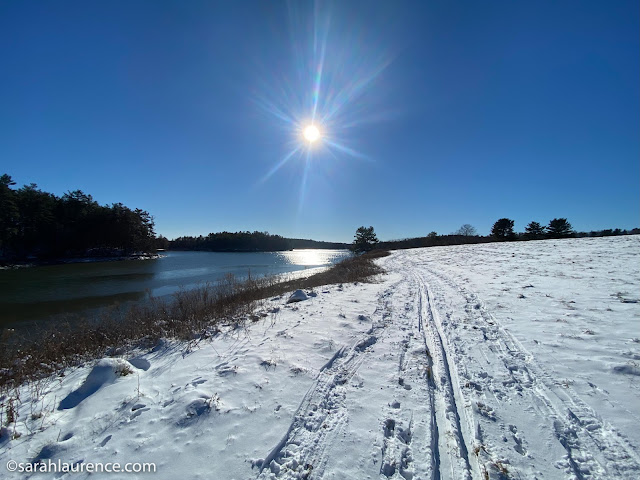
My coastal town in Maine got 18 inches of snow in the blizzard. Great skiing before the rain!
Click icon for more
book review blogs
@Barrie Summy
To celebrate Hanukkah, my family lights the menorah for eight nights; my husband makes the most delicious latkes (potato pancakes), and I have always given our children books. When shopping for books by diverse authors this holiday season, remember to include Jewish writers. Their stories aren't just for Hanukkah. We can all learn so much about the world by reading about other cultures and key moments in history.
One of my favorite Jewish writers is Alice Hoffman, the author of more than thirty books, many of them national bestsellers. In her 2019 novel, The World That We Knew, a twelve-year-old girl flees Nazi Germany to France with the help of a golem, a magical creature whose existence is as much a blessing as a curse. Despite this touch of magical realism, the mostly realistic narrative doesn't stray far from the facts of history.
What I found most interesting was the exploration of mysticism and female agency within the Jewish faith. I loved how Hoffman adapted patriarchal practices to give her observant female characters more freedom and power. There are also strong male characters, both Catholic and Jewish, but women and girls drive the narrative. The female golem made me rethink what it means to be human and a mother. The magical elements enhanced the story without detracting from the heroism of the French Resistance nor the horrors of the Holocaust. The writing was sublime.
Although The World That We Knew was written for adults, most of the characters are teenagers and the narrative is fast-paced and hopeful so it would crossover well to younger readers. My one and only criticism is the title is way too vague. This unforgettable book deserved a title easier to remember so write it down now. Thanks, Cathy at Main Point Books, for the book recommendation!
Click icon for more
book review blogs
@Barrie Summy
If you loved All the Light We Cannot See as much as I did, you'll be delighted to hear that Anthony Doerr will be releasing a new and equally epic novel, Cloud Cuckoo Land, on September 28th. His latest book is structurally more complex as it is narrated in multiple voices from antiquity, the recent past, and the future. It’s an ode to ancient texts, to libraries, and most of all, to readers.
The historical storyline follows two teenagers on opposite sides of a walled city during the 1453 siege of Constantinople. Anna is an orphan who should be embroidering birds and flowers for Christian priests but instead sneaks off to learn how to read Greek. Beyond the fortified walls, Omeir is more concerned in the wellbeing of his oxen than in the plunders of war. A birth defect makes it easier for him to win the love of animals than of people outside his family, but of all the characters, Omeir is the least bitter and the most capable and generous.
The contemporary storyline is set in Idaho and alternates between a troubled youth, Seymour, who befriends a threatened owl, and an 86-year-old Korean War veteran, Zeno, who is struggling to translate fragments of an ancient Greek text. I found it interesting that the "contemporary" storyline was set in February 2020, right before the pandemic. Perhaps to avoid its absence from the narrative? Some savvy editor or perhaps the author himself might have adjusted the dates right before the galleys were printed. I'm guessing that the pandemic will divide literature like World War II did in the last century.
The futuristic story is narrated only from the perspective of Konstance, a teenage girl on an arklike spaceship to save humanity from the climate crisis. To avoid spoilers, I won't say much about this storyline other than it was the most compelling and had a brilliant plot twist that took even a seasoned reader like me by surprise. My only criticism was I would have liked to have learned more about Konstance's future. The other storylines were better resolved, but all three were woven together well.
Cloud Cuckoo Land was brilliantly crafted. Although the galley was 618 pages and covered equally weighty material, it was a fast read with short cliffhanger chapters and alternating narratives. I read most of it over one weekend, and it was a welcome escape from the current worries of the world, even though it dealt with many of them. Like Harry Potter and the Seraphina series, Cloud Cuckoo Land brought me back to the childhood joy of getting lost in the alternative universe of a book. Although Doerr's novel was written for adults, it would crossover very well to teenagers.
With its time hopping stories and linked motifs, Cloud Cuckoo Land reminded me of David Mitchell’s masterpiece, Cloud Atlas (was the "cloud" in the goofy title an homage?) The environmental themes were also similar to The Overstory by Richard Powers. Following a book through time reminded me of another favorite, People of the Book by Geraldine Brooks. Even so, Cloud Cuckoo Land was original and will appeal to all book lovers.
"Each of these books, child, is a door, a gateway to another place and time. You have your whole life in front of you, and for all of it, you'll have this. It will be enough, don't you think?"
To research a novel about Jewish refugees in the Dominican Republic during World War II, I've been learning Spanish. Unable to travel, I connected with a conversational partner in Spain through the language exchange website Mixxer. Salomé lives in Galicia in the northwestern corner of Spain. Like my rural state of Maine, Galicia's geographic isolation protected the large elderly population from the higher Covid infection rates of more urban areas. Our pandemic stats have been remarkably similar, even though I was fully vaccinated by May 1st, and Salomé was only able to receive her first dose today. Another key difference: 87% of Spaniards want to be vaccinated and only 4% are anti-vax.
Americans should learn about the benefits of universal health insurance from our European allies, who view health as a right of citizenship, not as a divisive political issue. Still, the pandemic dealt a hard blow to Spain too, especially at the start, and vaccine scarcity has created additional challenges. During these stressful times, Salomé and I have found that learning another language has been an excellent diversion.
We also share a passion for books. I recommended that Salomé read Olive Kitteridge by Elizabeth Strout, a Pulitzer prize winning novel set in a fictional version of my coastal town. For our bilingual book club, I've been reading The Carpenter's Pencil by Manuel Rivas, a Galician classic about the Spanish Civil War. This short (166 pages) historical novel was written in Galician/gallego, a regional language which is more similar to Portuguese than to Spanish. Galician was banned under Franco and become the language of the resistance but returned to the school curriculum after the dictator's death.
Nearly trilingual Salomé read the book in Galician, but I needed the English and Spanish translations. Both were excellent, but the Spanish version was closer to the original and had interesting footnotes to explain the history. Salomé gave me more context and found photos to illustrate the narrative. I'm learning as much history and culture as grammar and vocabulary from our two hour weekly video chats. Our international friendship has been the silver lining of the pandemic.
The old prison island in Ría de Vigo, Galicia reminds us of Alcatraz in San Francisco.
The Carpenter's Pencil shows the brutality of the Spanish Civil War from the perspective of prison guard Herbal and his political prisoner, Doctor Daniel de Barca, whom he is ordered to kill. Fortunately, the spirit of a murdered painter gets inside Herbal's head, educating and manipulating the guard. Herbal represents the harsh sensibility of the Franco regime while Dr. Barca is nearly a saint in his selfless efforts to minister to the physical and emotional health of his fellow prisoners. From inside prison walls, we can best understand the horrors of the Franco regime of 1936-1975. To balance the darkness, there is a lovely romance between Barca and Marisa, a rebel with a cause, whom Herbal secretly adores.
This most original novella has more depth than books twice its length. It took me 6 weeks to finish only because I read very slowly in my third language. Although I can now understand Spanish newspapers and podcasts, the more literary language of novels is still beyond my intermediate level of instruction. Every night, I read a few pages in English and then again in Spanish. Now that I've finished, I'm listening to the Spanish audiobook to cement my comprehension and to appreciate the beauty of the language. I now understand why young children often want the same bedtime story over and over again! I'd recommend The Carpenter's Pencil to everyone in any language since its empowering message transcends translation. Me encantó esta novela histórica, y recomiendo que todos la lean.
Click icon for more
book review blogs
@Barrie Summy
Although Small Island is now one of my favorite historical novels, I was so disappointed by how one character treated other people that I quit reading for several years. Abandoned by her white father and Black mother, Hortense was raised in Jamaica by relatives who nourish and educate her but skimp on love. Seeking a better life, Hortense steals her best friend's boyfriend, a dashing Royal Air Force veteran, to immigrate to London. Her husband, Gilbert Joseph is hardworking and ambitious too, but his patient kindness and good humor stands in sharp contrast to her judgemental pride. Their struggle against racism is a fresh spin on the classic British World War II novel.
In 1948 Hortense sails into London and discovers a dirty, bombed out city and a shabby husband that fail to match her dreams. The narrative then rewinds to the backstories of the four central characters. The Josephs' white landlady, Queenie, is a delightfully irascible character who dares to rent rooms to people of color when her racist husband, Bernard, fails to return home from war. In many ways Bernard's miserable story is the most poignant of all, surprising me. A masterful storyteller can make you feel empathy in unexpected places.
Author Photo by Angus Muir
The child of Jamaican immigrants in England, author Andrea Levy has so much compassion for all of her characters. Their personal histories help the reader understand how childhoods circumscribed by misfortune, poverty, racism, and/or lost love have shaped these flawed characters. They frequently misunderstand each other, but the reader can piece together their true intentions by knowing the full story.
The titular "small island" is Jamaica or Great Britain, but it is also a metaphor for how people can isolate themselves by their own prejudices. This realistic novel shows how systemic racism corrupts and hurts everyone in its path. The heavy theme is lightened by a full cast of quirky Dickensian characters. If you can get past the abrasive opening chapters, this brilliant book builds momentum as the characters make mistakes but slowly learn to be a bit more tolerant and forgiving. By the end, we are left with hope.
As a writer, I received a second gift: inspiration. When crafting an historical novel it's hard to decide when to start the novel. The contemporary reader may need more background to situate themselves in an unfamiliar time period, but starting with backstory and historical context can bog down the narrative. Although two of the main characters of Small Island are from Jamaica, it made more sense to open in London because the book is about immigration. The best known example of this narrative structure, in medias res, would be the Odyssey. If starting in the middle of a journey worked for Homer and Levy, maybe it could work for me!
There's also a BBC adaptation with an all star cast: Naomie Harris (mom from Moonlight) as Hortense, Ruth Wilson (Rose from Downton Abbey) as Queenie, David Oyelowo (MLK from Selma) as Gilbert, and Benedict Cumberbatch (Sherlock) as Bernard.
Click icon for more
book review blogs
@Barrie Summy
This historical novel by Nobel Prize author Mario Vargas Llosa is absolutely brilliant in content, craft, and (dare I say) execution. The Feast of the Goat (La fiesta del chivo en español, 2000) recounts the events leading to the 1961 assassination of Rafael Trujillo, the dictator who ruled the Dominican Republic for thirty-one brutal years. This political thriller not only describes what happened, but by getting inside the head of Trujillo and his assassins, we start to understand his motives and how an authoritarian leader can maintain control by psychological manipulation as much as by force.
Not only did Trujillo imprison, torture, and frequently murder any Dominican who opposed him, he was also responsible for the Parsley Massacre of 1937 that killed around 20,000 Haitian residents, including women and children. Trujillo escaped global condemnation by being the leader of the only country to welcome extra Jewish refugees fleeing Nazi Germany (the subject of my work-in-progress).
It's one thing to abuse your enemies, but Trujillo was also cruel to his most loyal supporters, the Trujillistas. In return for prestige and wealth, he destroyed their integrity and dignity. He even slept with their wives and daughters. People tolerated his abuse in return for the economic prosperity and political autonomy that brought their country out of a near colonial relationship with the USA. All this is true.
Vargas Llosa's novel is told in three alternating points of view; only the first one is fictional. Urania, the daughter of a loyal minister, has returned to the island 35 years after Trujillo's death to confront the ghosts of her traumatic past. She's a 49-year-old successful lawyer who lives alone by choice in New York City. Vargas Llosa occasionally interrupts her third person limited point-of-view narration with a second person voice (you/tú) to balances her accusatory perspective, like a conflicted conscience. This shift in voice and sophisticated vocabulary made the book too difficult for me to read in the original Spanish so I switched to the excellent translation by Edith Grossman.
The second point-of-view is Trujillo on the final day of his life, reflecting back on his past glories and challenges. Vargas Llosa is at his best getting inside this Machiavellian mind. Trujillo is not interested in acquiring wealth beyond using it to maintain power to achieve his goals. He has a love-hate relationship with the USA: he credits being the strong leader he is to his training as a US Marine but would fight to the death should the Americans try to re-occupy his country. He wants to purge Haitians from the Dominican gene pool, and yet his grandmother was part Haitian, and he is attracted to mulata women. As an antagonist, Trujillo is multidimensional and well-developed, a most intriguing villain.
The final point of view is a chorus of assassins, all of them real people with mostly true backstories. These loyal supporters one-by-one turned on Trujillo. They are willing to sacrifice everything to regain their freedom. As they wait in a car to ambush Trujillo, they recall their past trajectories. Every assassin has a uniquely horrific story, and by sharing it, we learn about the history of the regime and the personal nature of Trujillo's control. El chivo/the goat was the popular nickname for their evil leader.
"Trujillo had also killed with a method that was slower and more perverse than when he had his prey shot, beaten to death, or fed to the sharks. He had killed him in stages, taking away his decency, his honor, his self-respect, his joy in living, his hopes and desires, turning him into a sack of bones tormented by the guilty conscience that had been destroying him gradually for so many years." (p90)
"...Trujillo había matado también, de manera más demorada y perversa que a los que liquidó a tiros, golpes o echándolos a los tiburones. A él lo mató por partes, quitándole la decencia, el honor, el respeto por sí mismo, la alegría de vivir, las esperanzas, los deseos, dejándolo convertido en un pellejo y unos huesos atormentados por esa mala conciencia que lo destruía a poquitos desde hacía tantos años." (p124, es más lírico en español.)
Read The Feast of the Goat to understand the danger of authoritarianism, a lesson all Americans need to learn right now. We cannot take democracy for granted. Also, this historical novel is fun to read, more like a political thriller than a textbook, but as full of facts. The author brings Trujillo back to life before killing him and destroying his legacy. I'd strongly recommend this book to everyone. I really want to see the film adaptation with Isabella Rossellini playing Urania!
Bruny Rivera, gracias por recomendarme leer esta novela maravillosa.
Greetings from snowy Maine!
Click icon for more
book review blogs
@Barrie Summy
To get inspiration for my work-in-progress about Jewish refugees in the Dominican Republic during World War II, I've been binge-reading historical novels. Last year, I was blissfully browsing in a New York bookstore, when I got in a conversation with a woman whose favorite genre was historical fiction. She recommended We Were the Lucky Ones by Georgia Hunter, a novel based on a true story about a Jewish family's escape from Nazi occupied Poland. The author's grandfather was the luckiest one. His harrowing journey to Brazil and the opportunities he found there reminded me of my great grandfather's mission to help bring Jewish refugees to the Dominican Republic.
The scope of We Were the Lucky Ones was surprisingly broad given the focus on one family. The five siblings and their parents in Poland scattered to Vichy France, Siberia, West Africa, Italy and Brazil. A family tree and chapters labeled by character, date, and location helps the reader keep track of the sprawling narrative. The Kurk family experienced a wide range of possible outcomes and witnessed a multitude of atrocities.
As a Jew, I would have found We Were the Lucky Ones hard to read without the promise that at least this family would survive. Even so, the mostly true story is an emotionally charged page-turner. My only criticism is that I wish there had been more chapters about Addy in Brazil since his story provides much needed light. However, debut author Georgia Hunter does a great job of humanizing history without minimizing tragedy and still manages to leave the reader with hope.
A long year ago, I wondered if I'd be up to the task of portraying a world-wide tragedy that would change the course of history, and now at the end of 2020, I can imagine that darkness. Nazi Germany and the Holocaust were far worse than our pandemic, but I can relate to the constant stress of a global catastrophe coupled to shocking attacks on democracy and scapegoating of the most vulnerable. Worse than any virus is the epidemic of fear, prejudice, and xenophobia.
There is no vaccine for hate, but we can learn how to avoid the mistakes of our past by studying history. Also a scientific study has shown that reading literary fiction increases empathy. On top of that, novels allow us to escape the confinement of our homes and to meet new people without any risk. This year my family won't be gathering in person, and we will be giving books as gifts.
My to-be-read stack of historical fiction: The Feast of the Goat (La fiesta del chivo) by Mario Vargas Llosa, Suite Française by Irene Némirovsky, Small Island by Andrea Levy, Cutting for Stone by Abraham Verghese, and the Neapolitan Novels by Elena Ferrante.
Do you have any other mid 20th century historical novels to recommend to me?
Click icon for more
book review blogs
@Barrie Summy
Lily King's recipe for Writers & Lovers will entice all readers: start with raw, confessional honesty, add a passion for gourmet food, spice with good and bad sex, mix well with poor judgement, and finally roast all the characters at high heat. If you're looking for a fun escape from these dystopian times, here's your time machine to 1990's Harvard Square.
A couple of years past thirty, Casey Peabody lives in a dingy room above a garage, working double shifts as a waitress to afford a few early hours to focus exclusively on her literary novel. Unpaid student loans and credit card bills are tossed directly into the garbage. She bikes to work, past squawking geese on the Charles River, her tears mixing with the incessant rain. Casey is mourning her mother's recent death, failed love affairs, and a traumatic childhood. She writes both to escape and to find herself. Her true name isn't even Casey.
"You don't realize how much effort you've put into covering things up until you try to dig them out."
I recommend reading Writers & Lovers slowly to savor the perfect sentences. This a writer's book, expertly crafted but still easy to read. The writing never distracts from the story-telling nor slows the pace. Humorous interludes, passionate moments, and sumptuous descriptions of food brighten the shadows of the backstory. The characters are equally enticing as flawed. It feels so real and familiar. This marvelous book captures, more than any other I've ever read, the hardships and rewards of the writer's life and gives me hope to keep working on my own novel.
Writers Disclosure: I have a personal connection to Writers & Lovers. After moving from Cambridge, Massachusetts to coastal Maine, I met Lily at the school our children attended. She looked so familiar, but I couldn't place her until reading her latest book. My husband and I had celebrated anniversaries, special birthdays, and graduate school degrees in the gorgeous rooftop garden of the old Upstairs at the Pudding in Harvard Square. Lily had been the perfect waitress, remembering everything without writing it down...until now. Brava, Lily!
In 1975 Phuc Tran was only a toddler when his family fled the chaos of Saigon for rural Carlisle, Pennsylvania. Although nearly all of the residents were white, Phuc refused to be defined by his ethnicity. Instead, he reinvented himself with the help of punk rock, skateboard tricks, and classic literature. His debut memoir, Sigh, Gone captures both the despair and exhilaration of being a misfit American teenager.
Phuc struggled growing up with parents who could barely speak English and with neighbors who couldn't pronounce his name or see beyond the Vietnam War. Although driven by love, his father's demand for academic perfection frequently crossed the line into physical abuse. Searching for a sense of belonging, Phuc found a chosen family of skateboarding punks, who shared his passion for iconoclastic music and reckless pranks. They accepted him as he was and offered him the loyalty he deserved.
While working at the public library, Phuc found salvation in literary heroes. Reading through an obscure list of great books by dead white men, Phuc aimed to master them all to win a scholarship to a New York university. Every chapter of his memoir is labeled after a great book, and their themes reverberate in his tumultuous life. His confessional story will make you laugh and cry, sometimes at the same time.
My family had been waiting eagerly for Phuc's memoir, and Sigh, Gone lived up to our high expectations. My daughter was lucky enough to have Phuc as her advisor in high school, where he taught Classics. Weekly "Awkward Lunch with Phuc" helped Gemma and many others survive those stressful but formative years. Phuc always put his students first and offered them the emotional support he wished he'd had in high school.
I would highly recommend Sigh, Gone to anyone mature enough for uncensored teenaged boyhood. Although written for adults, I'm certain teens would enjoy its brutal honesty and ironic humor as well. If you want a preview, watch Phuc's Tedx talk, "Grammar, Identity, and the Dark Side of the Subjunctive."
Click icon for more
book review blogs
@Barrie Summy
I usually try to match my vacation reading to the destination so being stuck at home this year was well timed. Twelve years ago, I'd devoured Olive Kitteridge by my part-time neighbor, Elizabeth Strout. Her eponymous protagonist was deeply flawed: judgemental, abrasive, and brutally honest. Olive was prejudiced toward rich and attractive urbanites and quick to blame the Jews, but she was also willing to put hate aside to help anyone in need and felt remorse for her mistakes. Olive was deliciously human and larger than life. How often is a retired middle school teacher the protagonist of a Pulitzer Prize winning novel?
Nine years ago at a small event for library volunteers, Liz Strout mentioned a few more Olive stories, a tenacious character who continued to haunt her as much as her fans. Olive, Again was finally published last fall, but I didn't want to read about home while traveling in Latin America. Due to the pandemic, we decided to rent a house on the water this summer, only ten miles from home. My son and his girlfriend joined us from Boston after Covid tests. Midcoast Maine was the perfect spot to read these stories, and made me appreciate our quaint hometown all the more. Crosby is a fictionalized blend of Brunswick and Harpswell. I know the bookshop keeper, have dined at the Dolphin, and often drive out to the point.
Olive, Again brought me home to my staycation. Like its predecessor, the stories featuring Olive as the central character are stronger than the ones in which she only plays a cameo. They link together to form a chronological novel. Of the thirteen stories, only three were disappointing: "The Walk" was as trite as a Hallmark greeting card, and "The End of the Civil War Days" as edgy as an elderly relative cracking a sexually explicit joke. "Exiles" was a follow up to The Burgess Boys, not my favorite of her novels. However, the other ten stories were stunning: original, emotionally resonant, and perfectly crafted. "Arrested" picks up where Olive Kitteridge left off: what happened between Olive and Republican Jack? "Labor" is classic Olive with childbirth disasters. "Light" might be the best story I've ever read about supporting a loved one with terminal illness. "Friend" connects Olive to a character from an earlier novel and gives us a satisfying ending.
When I finished Olive, Again, I was so bereft that I immediately reread the last story in Olive Kitteridge, which my daughter had just finished herself. It was a joy to share Olive with my daughter, to sit side by side, reading on the deck, overlooking the mudflats. We may not be able to visit friends and extended family, but I'm grateful to have had this time close to home with my husband, our children, a dog, and dear old Olive.
See you at low tide!
Click icon for more
book review blogs
@Barrie Summy
In 1960 Julia Alvarez was ten-years-old when her family fled the Dominican Republic for the USA. The SIM military police had uncovered her father's involvement in a plot against General Trujillo's authoritarian regime. That same year in the DR, three of the four Mirabal sisters were murdered. Their deaths were made to look like an accident but everyone knew the truth. Those brave young women, code-named the Butterflies (las Mariposas in Spanish), were the beloved symbols of the resistance. Author Julia Alvarez reimagined their story in her gorgeous historical novel, In the Time of the Butterflies. Although the book was first published 26 year ago, this tale of a narcissistic dictator and the brave young women who dared to defy him feels all the more relevant today.
The story itself was compelling, but what made me fall in love with In the Time of the Butterflies were the well developed characters, the gorgeous writing, and the interesting narrative structure. The chapters alternate between the perspectives of the four sisters, following them from their privileged girlhood to a revolutionary adulthood under the tyranny of Trujillo's reign. Each voice was unique. The eldest sister was the most cautious due to her overbearing husband. The second sister was a dedicated revolutionary, who secretly suffered under the burden of heroic expectations. The third sister was motivated by religious passion and family loyalty. The baby sister disclosed too much in her diaries, admitting her infatuation with the revolutionary men more than the cause, making her delightfully human. Every reader could identify with one of the sisters. It felt so real and relatable, this focus on their family life and the villainy of Trujillo, more than on the polemic of the revolution. However, the trajectory of their tragic lives clearly illustrates the horrors of authoritarianism.
A Blue Morpho butterfly with shut wings is well camouflaged. The spots look like owl eyes to scare predators.
In the "Postscript," Julia Alvarez explains why she decided to reimagine the personal life of the sisters: "As for the sisters of legend, wrapped in superlatives and ascended into myth, they were also finally inaccessible to me. I realized, too, that such deification was dangerous, the same god-making impulse that had created our tyrant. And ironically, by making them myth, we lost the Mirabals once more, dismissing the challenge of their courage as impossible for us, ordinary men and women."
This might be the treacherous mountain range that the Mirabal sister crossed to reach Puerta Plata.
Read In the Time of the Butterflies to find the courage to fight for change and to remember how to feel hope for a brighter future. The Butterflies will remind you to appreciate family and democracy and to take nothing for granted. I read the book to research my own historical novel about Jewish refugees in the Dominican Republic under Trujillo, and I feel all the more inspired. To practice my Spanish I'm also reading Alvarez's children's delightful Tía Lola series, which I'd recommend to 8-12 year-olds in either English or Spanish. Alvarez is a master of her craft and one of my favorite authors.
¡Vivan las Mariposas!
The gorgeous Blue Morpho butterfly near the end of her short life.
Click icon for more
book review blogs
@Barrie Summy