Wednesday, July 7, 2010

The Accidental Adventures of India McAllister by Charlotte Agell: review, interview and ARC give away

My fabulous writing critique partner, Charlotte Agell, has just published her 12th children’s book. The Accidental Adventures of India McAllister follows a mischievous nine-year-old tomboy as she struggles to understand the shifting relationships in her life.

Although the protagonist is called India, she was adopted from China. Her artist mother named her for India Ink. India loves her parents, but she resents her birth mother for giving her up. India feels doubly rejected when she has to share her father with his new partner, Richard. Then India’s best friend, a boy called Colby, starts flirting with her arch nemesis, Amanda.

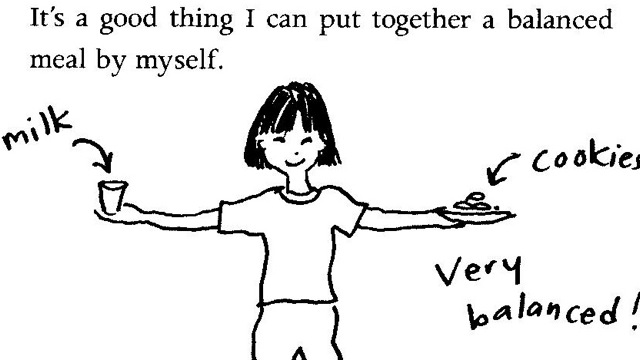
How’s a girl to cope with all this stress? India doesn’t mope. She seeks out adventures: searching for UFOs, spying on gossiping girls, playing detective and camping in the woods of Maine. India has a big heart and a nose for fun/trouble. Charlotte’s whimsical line drawings highlight the many humorous moments in this easy to read novel.

Although the material is very now, Charlotte's child-centered style with freedom to explore reminds me of the classic books from my childhood from Harriet the Spy to Jenny Linsky and the Cat Club. Families with step-parents, breast cancer survivors (India’s mother is one), same-sex partners and/or adopted children will especially appreciate the inclusiveness of this contemporary story. Charlotte covers “The Big Issues” in an age appropriate manner without being judgmental. For example India has typical problems accepting her new stepfather, but his being gay is a not an issue (except to the nosy neighbor.) I’m buying a copy for my half Japanese niece, who is starting fourth grade next year.

My daughter and I were intimately involved in India and its sequel (in the works.) Charlotte and I have been critiquing each other’s manuscripts for the past three years and have since become close friends. She encouraged me to try writing for teens as well as for adults, leading by her fine example. Since my daughter was the same age as the targeted audience, Charlotte asked for her input too. Any criticism my daughter and I had Charlotte has already responded to or ignored (like not calling a Chinese American girl India - a minor quibble) as suited her unique vision. We have enjoyed watching India grow over the past two years.

My 12-year-old daughter's review:

I first read The Accidental Adventures of India McAllister as a rough draft when I was ten and absolutely loved it, and I just reread it again recently as a published book, and I still love it! When I was ten, I enjoyed the story because it was new, cool and funny. Rereading it now, I notice more specific things like how it’s written very believably as a fourth grade girl narrator.

Each character is perfectly described and sculpted so I can picture how they are in my mind and how they act. One of the most fun parts about this book is India’s voice. She narrates out of her own eye and has a young, funny essence to how she does it. I really like her crazy dog, Tofu, because I can completely relate to having one hyper, lovable, woofing yellow bundle of craziness in our house! India was a super fun read, and I would definitely recommend it to kids around the age of eight to ten. I think they would really enjoy reading this book, I know I did!


Interview of Charlotte Agell
by Sarah Laurence and her daughter
(author photo by Sarah Laurence)

1. You’ve written 9 picture books and then 2 young adult novels (ages 12-18) as your own children grew up, what made you decide to try middle grade fiction (ages 8-12) now?

It was really more as if middle grade fiction decided to try me! I find that’s often the case with my books. I chew on an idea, and the idea itself decides its form. My hunch is also that spending so much time with 5th graders at the middle school where I teach contributed! The other thing is that I loved so many chapter books, growing up: Astrid Lindgren’s Pippi stories, the Moomintroll books…they were also illustrated, the latter by the author herself. I think the illustrations are similarly key to The Accidental Adventures of India McAllister (and if anybody doesn’t know Tove Jansson’s Moomintroll books, well, they should run to the nearest library and find them!).

2. You are happily married with two biological children, what led you to write about a girl adopted from China, who is being raised by a single mother and by a father and his gay partner in the fictional town of Wolfgang, Maine?

A fifth grader at the school where I work showed me her memoir. It contained very powerful writing about how she felt about her Chinese birth mother. This started me thinking…. India’s story is very, very different from this girl’s story, but that was definitely one of the seeds. As for India’s mother, she is a strong woman artist with a great deal on her plate, reminding me in some ways of my own mother, and how it was for her, after my father left. India's father is very much in her life, and part of this story is about how she gets to know his partner, Richard. For India, the issue is a step-parenting one. I was writing this book as Maine's Gay Marriage Law (approved by the legislature) went out to referendum. It didn't pass, unfortunately. I wish it had, as Andrew and Richard would definitely like to be married. Maybe they will be, in a later book.

3. Did you have anyone in your life a bit like India or did she just come up in your head?

India has elements of quite a few real life characters. She has my daughter’s love of reading and science, for example, and her willingness to be completely herself, even as a “tween.” She has a bit of me in her, too, as almost all my characters do. (I, too, made a snake mistake and saw a U.F.O.!) But in the end, India is mostly invention; she walked into my life and notebooks with attributes that came from who knows where! It’s funny about characters – they may be fictional but they feel very real to me.

4. Did you like as a kid (or still like) going on adventures like India?

Who doesn’t like adventures? Well, actually, as India demonstrates, they can be scary. I lived in Sweden, Canada, and Hong Kong as a kid, and often found myself wondering what on earth was going on. The sometimes strange situations I found myself in, due to culture bump or just growing up, made me wonder. Writing is, to me, mostly about wondering about things, just on paper. I’m still digesting that long ago U.F.O., and I’m guessing that this is why it makes my appearance here.

5. After 9 years teaching creative writing in a Gifted and Talented middle school program, what do you think is the most helpful writing advice? 

When an idea strikes you, write it down as immediately as possible (otherwise it is guaranteed to morph into its boring cousin). A corollary: always carry a notebook, or have one nearby. Write every day, even if it is only for a little while (some days, three minutes counts!) Writing is truly a matter of revision. Get those ideas down, sleep on them, take another look. Although ideas may strike like lightning, or waft in on the breeze, so much about writing involves perseverance. So, stick with writing, if you wish to write (and why not?) Finally, do not cook and write at the same time, for you will burn the onions. I keep this advice on my bulletin board, as a reminder of an unfortunate incident.

6. Which is more challenging: writing or illustrating? How does being responsible for both affect the editing process, as a manuscript becomes a published book? 

I draw a lot, but feel more like a writer who illustrates, rather than a true illustrator. This is because I have a great deal of stamina and patience for revising my writing, but I don’t much like to rework pictures. I will, of course, but not in that careful way of someone trying to get it just right. My illustrating style is on the loose side, and related to how I draw portraits (quickly, in one go). Both writing and illustration are at root about observation…just different ways to express what I notice.

7. What can you share about the sequel?

After this book, India goes to camp. There, she encounters her worst enemy and the action escalates. India’s second book of adventures is one big adventure, rather than chapter length vignettes (although it’s still a chapter book). I had a great deal of fun writing the second book, too. Its working title is "India McAllister Goes to Camp," but that might change. Writing and illustrating a series feels good to me, since India seems to have a lot more to tell me!

In our opinion, the sequel is even better than the first. We're looking forward to more adventures. Thank you, Charlotte!

Want More Info? Visit India’s blog at http://indiasink.wordpress.com. India's Ink is written from the character’s perspective and features Charlotte’s drawings. Note that the wrong URL was printed on the book cover (another accidental adventure?) You can read another one of our mother-daughter (and son) reviews of Charlotte Agell’s books here. Visit her website to learn more.

Brunswick Book Signing: Charlotte will be reading from India and signing at  Gulf of Maine Books in Brunswick, Maine on Saturday July 24 at 4pm. Sadly we'll miss it since that's the drop off day for my daughter's camp.

Reviewer’s Disclaimer: the publisher Henry Holt sent me both an Advanced Reader Copy and a finished copy of this book. I will be giving away the ARC below. All drawings by Charlotte Agell are reproduced with permission.

Free ARC Give Away: if you live in the U.S.A. and would like an Advanced Reader Copy of The Accidental Adventures of India McAllister, please mention so in your comment and give your email so I can reach you. On July 21, 2010 I will select one of you at random to receive the ARC. Published copies are already in American bookstores and available online anywhere through Amazon.

Click icon for more
book review blogs
@Barrie Summy

My novels: one of you blog readers recently stopped by the wonderful Gulf of Maine Books in Brunswick and asked to buy my novels. None are in print yet. My agent has submitted both S.A.D. and "as u like it" to publishers. I hope to announce good news on my blog some day. Gary Lawless has already promised me book signings at his Gulf of Maine Books. In the meantime, I'm working on a new novel, A MATCH FOR EVE, inspired by my sabbatical in Oxford, England. Thank you so much for your support! Knowing I have readers waiting is the best encouragement.

Wednesday, June 23, 2010

White Cat by Holly Black: capturing the teen boy voice in fiction

White Cat by Holly Black is like Harry Potter crossed with The Sopranos. In this first book of The Curse Workers series, the American Government has outlawed the practice of magic and everyone wears gloves to protect themselves. The curse workers, whose touch casts a spell, have gone underground to peddle their wares. There are some clever parallels to Prohibition and the rise of organized crime in our world. In White Cat the magical mafia deals in luck, pain, death, love, dreams, physical transformation and erased memories. There is a price to crime: every curse has a blow back on the curse worker. What a fabulous premise!

Lacking the ability to cast curses, Cassel is the black sheep of his magical family. His home life is a wreck since his father died and his mother was imprisoned for entrapping a wealthy man with her love spells. His magical brothers are caught up in schemes they won’t share with him. Even worse, Cassel is haunted by the hazy memory of killing his best friend, Lila. At boarding school Cassel tries to carve out a normal life, but disturbing dreams about a white cat haunt him. In his effort to uncover the truth, Cassel is sucked into the magical crime world of New Jersey.

I can see this fast-paced, frequently violent story being a big hit with teenaged boys. That’s not to say that teenaged girls and grown ups won’t enjoy White Cat too, but the target audience would be boys aged 14 and up who grew up with Harry Potter and are looking for something edgier. This would also be a great choice for reluctant readers. With all the criminal intrigue, con games and splattered blood, the experience of White Cat was more like gaming than reading, and yet the writing was excellent.

My one criticism was that sometimes the writing was too good. The lyrical descriptions seemed out of place coming from Cassel’s mobster mouth:
“Above the trees, their leaves the pale green of new buds, bats weave through the still bright sky. The air is heavy with the smell of crushed grass, threaded through with smoke. Somewhere someone’s burning the wet, half-decomposed foliage of winter.”
This doesn’t sound like a 17-year-old boy who organizes betting pools in his dorm and grew up in a dysfunctional criminal family. Later Cassel notices “hydrangeas” in a vase when meeting a scary crime lord. My 15-year-old son might recognize that word, but only after digging 3 holes for me to plant the flowering bushes in our garden. Cassel’s yard is full of weeds and his house is stuffed with rotting junk.

I’m not saying that a boy can’t have a lyrical voice, but we need a source in his character. Black could have made Cassel a bookworm or a closeted poet. Personally, I enjoyed those lyrical passages far more than the graphic descriptions of violence. As faults go, lyrical writing is a good one!

Despite the occasional voice disjoint, White Cat is a well crafted page-turner full of intriguing characters and surprising plot twists. I couldn't put this impressive book down. This was my first exposure to the talented Holly Black, and I’m sure it won’t be my last.

While working on my NOT CRICKET, with its alternating male-female narration, I’ve been seeking out young adult novels with convincing male voices that still have cross-gender appeal. Please recommend others in the comments if you know of any.

I'll be offline most of today getting my son off to 7 weeks canoeing in the wilderness, but I'll be back soon. He's taking The Poacher's Son by Paul Doiron with him.


Holly Black explaining the inspiration behind White Cat.

Reviewers Disclaimer: I bought this book on its release in May 2010 (June in the UK) without compensation. Thank you authors Kami Garcia and Margaret Stohl for recommending White Cat to me. Hydrangeas on Nantucket Island photo by me.

Wednesday, June 16, 2010

Morse Mountain in May

Spring paints vibrant color on a dull canvas.

Sky water draws faces on the marsh.

May light shines on pines, clinging to cliffs.

Bare branches grab the clouds,

While Lady Slippers dance in the woods,

And wildflowers flourish below.

Ferns wave goodbye to winter’s darkness.


Morse Mountain in:
 winter
autumn
late summer

Wednesday, June 9, 2010

25th High School Reunion in NYC

I thought I’d matured, but I felt a familiar wave of insecurity going back to school. It all came back: the cliques, the gossip and the physical scrutiny. A reunion could be a living nightmare. Who really wants to return to high school?

I spent my formative years at an artsy, academically intense private school on the Upper East Side of Manhattan. I loved Dalton, but it was tough. The class of ‘85 was assigned the library, and did I ever want to escape into a book, just like I used to. Instead I made the rounds and talked to almost everybody. It was especially nice to thank some of my former teachers. I had an excellent education.

About 40% of our class of 100 had returned and several of us had been in school together for 15 years. Everyone remembered me, but there were some I had difficulty recognizing. Time had changed men more than women physically, but the group dynamics hadn’t shifted.

The good news is most people get nicer over time. A girl who had tormented me in middle school recently sent an apologetic email, anticipating our reunion.  Worst experience: the woman who took out her BlackBerry as soon as I approached her “cool” clique. I laughed it off. Everyone else was friendly and eager to catch up.

I was still the oddball bohemian, but that was okay. I was lucky to have a group of friends who appreciated my differences back in high school. We are still close today. What touched me was how supportive everyone else was about my writing, even though I’m not published yet. People were eager to read my novels and hear about life in Maine. Most were still in NYC or in other big cities, working in business, law, real estate etc. Best gossip: two divorced classmates had hooked up.

The after party was at the Wright Bar in the Guggenheim Museum. Revisiting high school was easier with a drink in hand, and I’m not much of a drinker.

What did I learn? The people who seemed happiest in high school seemed the least satisfied with adulthood. Conformity is only a teen survival skill. Fulfillment comes from searching inside for your own creative spark. A good school, like mine, provides a broad choice of matches.

As for the painful experiences, they make great material. That’s the best thing about being a writer. The main reason I write young adult fiction (as well as adult fiction) is that the teen years made me who I am today. I write the books I would have wanted to read back then. High school has pigeonholes, but birds can fly. My advice to teens: open your wings.

Wednesday, June 2, 2010

The Girl Who Fell From the Sky by Heidi Durrow: review and interview

The Girl Who Fell From The Sky by Heidi W. Durrow is a stunning debut novel about a sole survivor of a family tragedy. Rachel, her Danish mother, her brother and her baby sister fell from the roof of their Chicago apartment building. Was it an accident or were they pushed? Rachel literally turns a deaf ear and focuses on the more immediate struggle of fitting into the African American community in Portland, Oregon, where her grandmother lives. Rachel has brown skin, blue eyes and "speaks white." Who is she?

The story unfolds in several voices: Rachel in the first person, her mother's journals, and three other characters in the third person. One narrator changes his name from  Jamie to Brick. It also skips back and forth between three time periods and places: backstory in Germany, Chicago after the accident and Portland in the five years following. I had to reread some passages to follow the asynchronous narrative. It would have been less confusing to have just 2 narrators, Rachel and Brick (without a name change.) The journals could have filled in the gaps, without adding 2 more voices.

Still, it was well worth the effort to untangle the plot strings. The dialogue sounds realistic and the metaphors are gorgeously poetic. Rachel and Brick are fabulous leads, but even the minor characters are well developed. The real mystery is not the accident but Rachel's identity in a society that can't see gradations between black and white. There is prejudice and hate, but there is also love and acceptance. This lyrical and most original story stayed with me long after I finished it.

Heidi Durrow, like her protagonist, has a Dutch mother and an African-American father, who served in Germany. The Girl Who Fell From The Sky sings true to the multi-cultural experience of modern life. If you are looking for a fresh new voice with a meaningful message, this literary novel is for you.

My Interview with Heidi Durrow
author photo by Timothi Jane Graham

Sarah Laurence: Although your voice is distinct and original, I was reminded of both The Bluest Eye and Beloved by Toni Morrison. Was Morrison an influence?

Heidi Durrow: I adore Toni Morrison. And she was a definite influence on me as a writer--She was my a model of lyrical, beautiful writing--I love her sentences!--And beyond that--I think of this book as kind of a response to The Bluest Eye. My protagonist Rachel isn't the young brown girl who yearns for blue eyes, but the young brown girl who has them and must deal with what that means to the world.

What made you decide to set the narrative in the 1980’s?

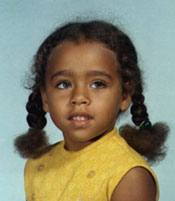
I wrote what I knew. I came of age during that time and I wanted to include details about the state of race relations and racial consciousness during that time. That's me at age twelve (photo to left.)

How has the biracial experience changed over the past decades? 

I want to say that growing up biracial now isn't as difficult as it was when I was growing up. President Obama and the many biracial people in the media, arts, and sports who actually talk about their mixed identities has made it less isolating. But still, I think kids in the smaller towns and cities--they still are dealing with many of the same things that I dealt with as a kid. We, as a country, are still invested in labels. And it's difficult for people to understand a multiplicity of experience and identity.

The protagonist, Rachel, is a girl aged 11-16. Why did you decide to write the story for adults instead of for young adults? 

I think of the book as written for adults, but I also think young people can get a lot out of it. Especially young women. I think the YA label is more a marketing term than descriptive of a book. Take The Book Thief for example (one of my all-time favorites)--it was marketed as YA here, but not in Australia where it was first published. I would like to think that I am writing for teens as well as adults. As I wrote the book, I was very much aware that I wanted to write a book I wish I could have read as a 15-year-old me.

Why did you tell the story in multiple voices/time frames? Was this narrative structure in place from the start or did it evolve over time?

The narrative structure evolved over the course of some two dozen revisions. I started writing the book in third-person from Rachel's perspective as an adult. But then I struck upon her voice in the first-person right at age 11 and then it took off from there. The other characters' perspectives came in as I realized that Rachel was an unreliable narrator and I needed other people to give the reader information and the character Jamie/Brick came about because I realized that Rachel needed a witness. I think in real life too--when something bad happens to you, it's important to have someone say yes, that was a bad thing. I recognize that too.

What was your road to publication like?

Long! Very long. I started the book in 1997 and it took 12 years to write the book finished and get it published. I got so many rejections at every level. I had teachers along the way who told me to give up on it and put it away. I just couldn't let it go. I kept working on it and for every "no" I got I tried to find information in the no and not take it personally. At some point, I started to win contests, and grants, and residencies. I took it step by step and finally my dream came true (Heidi in 1974 to right.)

What is the best writing advice you have received?

You just need one gatekeeper to say yes to your story. You just have to find that gatekeeper. I got lucky. My gatekeeper was Barbara Kingsolver. I am forever grateful!

Wow! Barbara Kingsolver is one of my favorite authors. How did you connect with her?


Barbara Kingsolver chose my book for the Bellwether Prize. She created and fully funds the prize which comes with $25,000 and a book contract. I did get to meet her when she was on tour for The Lacuna. And she was just as warm and wonderful, elegant, gracious and funny as I imagined her to be!

What is your next book project?

It's based on the life of a famous mulatto strongwoman and circus performer of the late 1800s. It's set in Paris and London and the other main characters are a very hairy Laotian girl who is exhibited as a "freak" and Edgar Degas. I'm having a lot of fun with it. And then, I've also been taking notes on a kind of sequel to The Girl . . . I didn't write the book with that in mind, but as I travel around and people ask me questions about the characters they all want to know what happens next. I kind of want to know too.

Thank you, Heidi, and good luck!

Reviewer's Disclaimer: I bought this book (published February 25, 2010) after reading a review in The New York Times. I have a biracial character in my young adult novel, as u like it, so Durrow's novel caught my eye. I received no free products or compensation.  The childhood photos and author photo were supplied by Heidi Durrow and reproduced with permission.  

Click icon for more
book review blogs
@Barrie Summy